

Brief Intro
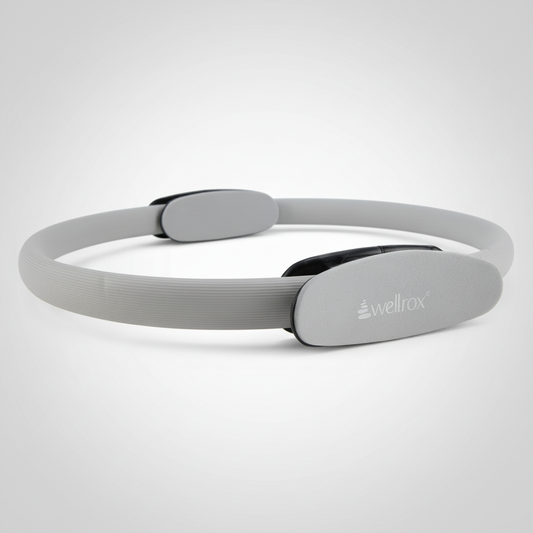
Whether you call it a Fitness Ring, Magic Circle or Fitness Circle, a flexible Wellrox Pilates Ring is designed to be squeezed, pulled, and stretched in various directions, to engage different muscle groups.
Almost every muscle - your glutes, quads, hamstrings, inner (adductor) and outer (abductor) thighs, triceps, chest, shoulders, abdominals, and upper and lower back - can be strengthened and challenged in ways that differ from traditional workouts.
When used isometrically, as with static holds, the workout ring increases muscular strength and endurance as well as balance and coordination.
When used isotonically, as with either slow contractional movement or pulses, the exercise ring increases muscular strength and mass as well as range of motion.
Ready to work your way to a fitter, more flexible and mobile body with a Wellrox Pilates Ring? Here are ten effective exercises for full-body toning, core engagement, muscle strengthening and body stability:
1. Squeeze Squats

Stand with your feet a little more than hip-width apart. Place the Pilates ring between your thighs, just above your knees in a relaxed stance with knees slightly bent and toes pointed forward. On an inhale, gently squeeze the ring using your inner thighs as you lower into a squat. Hold for a count of three, then slowly push back up on the exhale. Try 15-20 reps while maintaining an upright posture and engaging your core and glutes.

Isometric variation: Step into the ring with your legs about hip-width apart until it is around your calves. Pressure against the inner sides of the ring should hold it in place. While keeping pressure against the ring lower into a deep squat, keeping the chest high and hips tucked. Try 15-20 reps.
A regular squat engages the quadriceps, glutes, and hamstrings, as well as the core, calves, and hip adductors and abductors. This compound movement also requires the upper back to stabilize the load and maintain an upright torso. Adding the Pilates Ring engages the adductors, abductors and stabilizers even more deeply.
2. Calf Raises

Place the Pilates ring between your legs right above your ankles. Inhale. Keeping your core engaged and body aligned, exhale slowly and raise your heels off the ground while squeezing the ring. Slowly lower. Try 15-20 reps.

Outer Variation: Place the ring around your calves and point your toes either outward or inward. Press against the sides of the ring while raising your heels. This exercise focuses on the outer glutes and abductors.
While primarily targeting the calves, this exercise also engages muscles in the ankles, arches and toes. When performed with a Pilates ring, this exercise creates isometric resistance and engages the adductors as well as deep, stabilizing muscles in the calves, ankles, pelvic region and core.
3. Arm Press

Stand with your core engaged and shoulders back holding the Pilates ring straight out in front of your chest. Inhale. On the exhale and only slightly bending your elbows, press inward on the ring for a count of 3 while engaging your chest, shoulders, and triceps. Gently release with an inhale. Try 10-15 reps.

Overhead Variation: Raise the workout ring overhead on an inhale while keeping your shoulders down and away from your ears. On the exhale press inward on the ring for a count of 3 while engaging your upper back, shoulders, and triceps. Gently release while lowering the ring back to chest height. Try 10-15 reps.
This exercise strengthens your chest, arms and shoulders while stabilizing the upper body, improving posture and mobility. It also engages the core, promoting better stability and balance.
4. Inner Thigh Burn

Sit on your mat with your feet flat on the floor. Place the ring between your thighs right above your knees. Place your hands on the floor behind you, palms forward to help support your back and open your shoulders. Draw in through your navel and squeeze your inner thighs together as you exhale. Try to engage your thighs, deep lower abdominals and pelvic floor on the squeeze. Release slowly. Try 10-15 reps.
5. Bridge Squeeze

Lie face-up on your mat with your legs hip-width apart and bent at the knees. You should be able to just touch your heels with the tips of your fingers. Place the workout ring between your knees and lower your arms to the floor. Engage your core, inhale and
lift your hips towards the ceiling on the exhale by squeezing your glutes while also squeezing your knees together. Try to draw up your pelvic floor as well. Make sure not to over-extend your hips. Hold at the top for a count of three and release down. Try 15-20 reps. For a greater challenge maintain pressure on the ring throughout.

Single-Leg Variation: Extend one leg toward the ceiling throughout the exercise while keeping your hip bones level with each other. Try 8-10 reps per side.
This exercise strengthens your glutes, hamstrings and pelvic floor and improves lower back mobility. The single-leg variation focuses on unilateral strength, which can improve stability and correct strength imbalances in the lower body.
6. The Hundred Challenge

A Classic Pilates Exercise Lie on your back holding the Pilates ring between your ankles. Press your lower back into the floor and lift your head and neck with your arms extended outward. Extend your legs straight, finding an angle that works for you (about 45 degrees). If too challenging, bent your legs at a 90 degree angle and place the ring between your inner thighs. Pump your arms up and down while squeezing the ring for a total of 100 pumps. Inhale and exhale in five-count, controlled breaths. Maintain an engaged neutral core throughout.
This exercise will target your core endurance and lower body stability. It engages and strengthens your adductors, stabilizing your pelvis and improving agility.

Abductor Variation: Place the ring on the outside of your ankles (with legs straight) or thighs (with legs bent) and apply outward pressure. This variation enhances lateral leg movements which contribute significantly to hip stability, leg alignment and proper gait, which is crucial for knee joint health.
7. Supine Leg Press

Lie face-up on your mat with your arms by your sides, knees bent, and feet flat on the floor. Place the Pilates ring between your ankles. Press your lower back into the floor and lift your feet, bringing your knees above your hips to create a 90-degree angle with your legs. Gently squeeze inward with your ankles while extending your legs straight up towards the ceiling. Return to the 90-degree angle position. Try 10-15 reps while keeping your core engaged.
Abductor Variation: Place the ring around your ankles and keep outward pressure.
In addition to your adductor/abductor muscles, this exercise primarily works the quads, hamstrings, and glutes. Strengthening these muscles contributes to better support for
the knees and hips. This exercise also engages the core muscles, further stabilizing the spine.
8. Crunches

Lie face-up on your mat and place the ring between your knees. On an exhale with hands behind your head, squeeze while curling your torso up. Hold for a count of 3 and release. Try 15-20 reps.

Advanced Variation: Lie on your back with the ring between your ankles and your legs bent at 90 degree. Curl up on an exhale while extending your legs out and reaching your arms forward.
This exercise targets the abdominals and inner thighs.
9. Side Plank Clams

Lie on your right side with knees bent at 90 degrees and your torso supported on your right elbow with your forearm flat on the mat. Place the ring between your thighs, just above your knees. Push up into a side plank, making sure your shoulders and hips are aligned. Squeeze the left leg down for 3 to 5 reps. Be sure not to rotate your pelvis. Lower back down to return to start position. Switch sides and repeat.

Outer Variation: Place the ring around your thighs, just above your knees. Push up into a side plank, making sure your shoulders and hips are aligned. Lift and externally rotate the left leg while keeping your pelvis stable for 3 to 5 reps. Lower back down to return to start position. Switch sides and repeat.
This exercise targets both the lower body and core. The clamshell component primarily strengthens and engages the hip abductors and the glutes, as well as the fasciae on the top hip. It also significantly activates the obliques and abdominals.
10. Pilates Ring Swan Dive

Lay face-down on a mat with your legs extended straight and the ring standing on one handle a few inches from the top of your head. On an exhale, press down on the top handle of the ring with both hands, engage your core and glutes and lift your head, chest and ribs, keeping the spine long. Release slowly back down. Try 8-12 reps.

Baby Swan Variation: Grab the ring by the handles and place under your face. Lift just enough to get your shoulders off of the floor and extend the ring forward and return back to under your face. Try 8-10 reps.
This exercise engages your core and glutes while strengthening your upper and lower back, shoulders and triceps.

Cervical Rotation Variation: Lay face down on a mat with legs extended straight and head facing one direction. Hold the ring behind you in both palms above your lower back with elbows bent. Engage your entire back body and lift your legs and chest up off the mat while extending your arms straight back. Rotate your head to the other side and relax the body slowly returning to the starting position. Try 6-10 reps.
Like the Swan Dive, this exercise engages the entire back, core, glutes, upper and mid-shoulder muscles and triceps. It has the added advantage of stretching out and strengthening the deep cervical muscles and soft tissue.

