

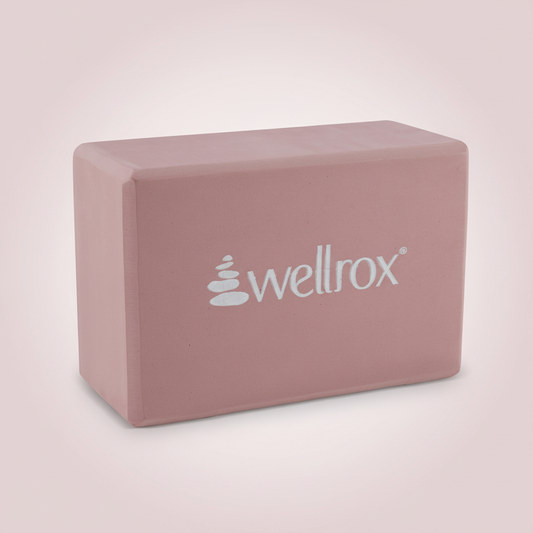
Wellrox yoga blocks are both soft to the touch and firm in density, forming a stable and comfortable prop. As a premium block, it is thick and dense without being too heavy, which means it can be moved easily but will also stay in place.
Yoga blocks have a multitude of purposes in anyone’s routine, both within yoga and without. It can help align the body properly, support poses and deepen stretches. It can also be used to intensify certain exercises, provide support for massage balls and facilitate fascial release. Wellrox’s combination of softness, stability and density makes it an ideal block for every intended use.
Here are some suggested ways to use your Wellrox block:
1. Support and Alignment
Standing poses like Triangle (Trikonasana) or Half Moon (Ardha Chandrasana) often require flexibility and balance. Placing a block under the lower hand brings the floor closer to you, helping maintain a straight spine and preventing unnecessary strain. It also acts as a stabilizer, allowing you to focus on muscle engagement and proper body alignment rather than reaching the ground.
In seated poses, sitting on a block can make a big difference in postures like Easy Pose (Sukhasana) or Forward Fold (Paschimottanasana). Elevating the hips helps tilt the pelvis forward, thereby easing tension in the knees, hips and lower back and promoting better spinal alignment. This setup is particularly beneficial for practitioners with tight hips or hamstrings.
For particularly challenging balance poses, blocks can be used as stepping-stones in learning them. They elevate the hands in Crow (Bakasana) and provide a landing surface for the head in Headstand preparation. This creates a safer environment to explore new movements and transitions while maintaining proper form.
2. Deepen Stretching
In addition to making certain poses more accessible and effective, blocks can add an element of resistance or leverage, assisting in gradually increasing flexibility. Using the block under your elbows in child’s pose provides a deeper shoulder opening while supporting your arms. Using blocks under your hands lets you gradually increase stretch intensity in poses like forward folds, lunges, or splits without forcing range of motion. Since the block supports part of your weight, muscles can relax more, which encourages a deeper, safer stretch over
time. Placing a block under your forward leg in certain standing poses, like Pyramid Pose, can help anchor the back leg while increasing the distance between your hands and the floor, allowing a more intense stretch.
3. Build Strength
When performing core-based exercises, like Pilates, a block can be used to engage additional muscle groups to intensify the workout. Pressing a block between your thighs in floor exercises, like the glute bridge, Boat Pose and Plank, isometrically activates the adductor muscles, engages deep core muscles and supports pelvic alignment. While performing lower body exercises, such as squats or lunges, pressing a block between the hands will actively engage arms and shoulders. By adding a twist toward the outer leg, obliques and deep core muscles are activated, as well as hip and glute stabilizers to counteract the twisting motion.
The block can also be used to increase your range of motion in exercises like lunges, pushups and tri-dips, by placing a block under your hands or feet. Increasing the distance over which the exercise is performed increases muscular performance.
4. Rest and Recovery
A yoga block can be a powerful tool for rest and recovery, supporting your body in restorative poses that release tension, deepen relaxation, and aid muscle recovery. When used thoughtfully, it makes restorative and recuperative poses more accessible and comfortable, enabling you to enjoy deep relaxation after strenuous activity or long days.
-
- To open your heart and chest, lie back over a block placed horizontally under your shoulder blades, with another block or folded blanket under your head.
- For low-back and hip relief, lie on your back with your knees bent. Lift your hips and slide a block under your sacrum on its lowest height, providing a wide surface, then let your pelvis rest fully on the block.
- To release your lower back, lie on your back, drop both knees to one side onto a block, so the legs are supported. The added block softens the twist, allows the back muscles relax, and is easier to hold for several minutes.
- For a soothing Savasana, lie on your back with a block or two under your calves or knees.
5. Massage and Myofascial Release
In addition to its use as a cushioned platform to support massage balls in targeted areas, yoga block can be used under various muscle groups in seated or prone positions to facilitate the release of fascia surrounding your muscles. You can allow your body to speak to you on what feels good, while keeping in mind a few principles. Avoid direct pressure
into bone structure or nerves. If you feel burning, shooting, tingling or radiating pain, this indicates nerve pressure and either adjust or stop. Avoid sensitive or tender areas and keep the pressure, intensity and duration at a comfortable level. If the block is too intense, you can cushion it with a folded blanket or towel. Maintain consistent breath and experiment with different techniques. If you add movement, move in the direction of the targeted muscle fibers.
For example, to target the thighs, try lying down face down. Slide your block under your thigh just above your knee on its lowest height setting so that the long edge of the block is parallel to the short edge of your mat. Release the weight of your thigh and breathe deeply. You can add in a forward and back rocking motion by rising up onto your forearms and tucking your toes under.
Whether you choose to use your Yoga block to stretch, strengthen, support, relax or massage your body, pay attention to how it feels to maximize the benefits and feel great!

